 15400 Oakwood Drive, Romulus MI 48174
 734-857-1633


Artificial intelligence is pushing data center infrastructure to its absolute limits, and heat exchanger manufacturing sits right at the center of this massive shift. Hyperscale facilities supporting generative AI, high-performance computing (HPC), and heavy cloud workloads have driven rack power densities from a traditional 5 to 15 kW up to an astonishing 50 to 140 kW. Leading AI clusters push those numbers even higher.
Traditional air cooling simply cannot handle this thermal load. Because of this, liquid cooling systems—which rely heavily on precision heat exchangers—have transitioned from a niche technology to an absolute necessity for efficient thermal management.
For heat exchanger manufacturers, this is not a passing trend. It represents an explosive, sustained demand for specialized production equipment. Let us explore the cooling crisis driving this adoption, the technologies leading the charge, and how manufacturers can scale to meet hyperscale needs.
The Cooling Crisis Driving Liquid Cooling Adoption
AI training and inference workloads have escalated GPU thermal design power beyond 1,000 watts per single chip. Data centers must respond to keep servers from melting down. They are adopting direct-to-chip (D2C) cold plates, rear-door heat exchangers (RDHx), and full immersion tanks at unprecedented rates.
These liquid-based solutions cut cooling energy use by 30 to 50 percent while supporting far higher rack densities than legacy air systems. Every single liquid cooling architecture depends on high-performance heat exchangers to move heat from dielectric fluids or water-glycol loops into facility chilled water or outdoor rejection systems.
Here is how heat exchangers fit into the three leading liquid cooling architectures:
Direct Chip Cooling
In this setup, cold plates sit directly on CPUs and GPUs. Heated coolant flows from these plates to a coolant distribution unit (CDU). The CDU features integrated heat exchangers that transfer the captured heat away from the sensitive electronics and out to the broader facility cooling loop. Precision is critical here, as any pressure drop or inefficiency can lead to immediate hardware throttling.
Immersion Cooling
Immersion cooling takes a more radical approach. Servers are completely submerged in a bath of non-conductive dielectric fluid. As the servers heat up, the fluid absorbs the thermal energy. The system then pumps this hot fluid through external heat exchangers to transfer the thermal load to a secondary water loop. This requires heat exchangers built to handle specialized, sometimes corrosive, synthetic fluids without degrading.
Rear-Door Heat Exchange
These systems replace the standard back door of a server rack with a large, active cooling coil. Rack-scale fin-and-tube designs capture exhaust heat the moment it leaves the servers, cooling the air before it even enters the data center room. This neutralizes the heat at the source and requires incredibly efficient, tightly packed coil designs.
Why Heat Exchanger Manufacturers Face Record Demand
Hyperscalers and colocation providers now have incredibly strict requirements for their cooling infrastructure. They require:
- High-precision designs: Fin-and-tube, plate, or microchannel systems must handle corrosive dielectric fluids and extreme temperature differentials without failing.
- Modular scalability: Components must allow rapid reconfiguration across custom AI server racks.
- Absolute reliability: Data centers demand corrosion-resistant materials and leak-proof assemblies that deliver 99.999% uptime. A single leak can destroy millions of dollars in AI hardware.
This surge creates a tremendous manufacturing boom. Equipment providers capable of high-throughput roll-forming, core assembly automation, precision finning, and tube expansion lines are seeing their orders skyrocket. Traditional HVAC or automotive heat exchanger production lines are actively being retooled. Manufacturers must achieve tighter tolerances, faster cycle times, and adapt to data-center-specific materials to win these lucrative contracts.
How Manufacturing Equipment Innovation Meets Hyperscale Needs
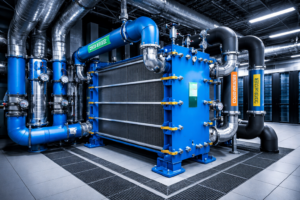 Leaders in data center heat exchanger manufacturing are investing heavily in flexible automation. To keep up with the bespoke needs of different server architectures, factories cannot rely on rigid, single-purpose assembly lines.
Advanced fin mills, automated brazing systems, and integrated quality control protocols are now standard. Systems that offer automated leak testing, flow verification, and thermal performance validation enable the rapid production of custom geometries for next-generation CDUs and immersion tanks.
The payoff for manufacturers is massive. By upgrading their equipment, they can pivot from legacy markets into this high-growth vertical without massive capital overhauls. They can scale their output rapidly while maintaining the exact precision that hyperscalers demand.
Ready to Scale Your Data Center Heat Exchanger Manufacturing?
Livernois Engineering, along with its partner companies, Innovation Automation and Tridan, has perfected the machines that build high-performance heat exchangers. From advanced fin mills and core assembly automation to roll-forming lines and fully integrated custom solutions, we understand the precision this industry demands.
“Behind every high-performance data center cooling system is a sophisticated manufacturing ecosystem — powered by specialized automation, fin forming, and assembly equipment from companies like Livernois Engineering and Tridan.”
Whether you are expanding into liquid cooling for AI data centers or optimizing your existing lines for higher throughput, our equipment helps you meet hyperscale demand today. The future of data center cooling is undeniably liquid. We have the manufacturing equipment ready to help you build it.
Explore our heat exchanger manufacturing solutions or contact our team to discuss how we can support your growth plans.
 734-857-1633